i) What forms can opening sequences take? Can you list the conventional features of opening sequences?
Opening sequences are the introduction to a film, and used by the director and producers to grab the audiences attention and interest. They are also used as a tool by the audience to recognise whether or not this film appeals to them.
Conventions of an opening sequence include:
- Setting the scene: The scene allows the audience to know where and when the film is going to take place, therefore also introducing the genre as there are particular sets for different genres, for example a high school for a teenage style romcom
- Sound effects and music: This further enhances the genre of the film as, for example, an audience would identify dark, minor sounding music or heavy breathing sound effects with a horror film. This can be used as another tool by the director to create tension or set the mood to draw the audience in
- Introduction to main/significant characters: Typically, an opening sequence would introduce the protaganist and possibly the antagonist as well. This allows the audience to connect with the main characters early on, enhancing the pleasure gained from what happens to them later on, either the protagonist winning or the antagonist being defeated
- Opening equilibrium: This is the culmination of the scene and characters, so it can then be disrupted creating the plot for the rest of the film
- Promise for what is to come: Opening sequences generally include subtle clues as to what storylines or themes are to come, which the director has placed in to make a promise and expectation of the audience of what to expect from the film.
- Credits: The creators/makers of the film can be established. The style they are written in also enhances the genre and style of the film, for example big bubbly pink writing for a romcom; shaking, faded black writing for a horror
ii) What narrative functions of opening sequences can you identify?
- Narrative story refers to all events, grouped to create a narrative sequence
- Opening sequences create audience understanding of events
- Time and space and the way it is shown is a key feature of narrative sequences, and it can be portrayed as compressed, linear or cyclical
- Narrative functions are vastly portrayed through the use of mise-en-scene, camerawork and lighting
- Film narratives are closed, in that they finish within the one viewing, with the exception of a small plot line to be continued through a sequel
- Main characters are conventially shown so that we are able to see individuals in great depth
- An audience is able to identify with characters, both protagonist and antagonists, with different relationships
- Directors can use lighting to help create the audience's opinion of a character, for example bright lighting on the victim in a horror or thriller
iii) What do audiences gain from watching the opening sequence?
- Understanding of the style and (sub) genre of the film and therefore recognise what to expect, what pleasures, and whether or not this film is enjoyable for them
- They can connect with the characters and their situation to then enjoy and anticipate what happens to them later on
- The conventions can be changed in, for example horror films, which can then use this to shock the audience and remove the apparently main character early on. For example, Scream
iv) What do film-makers gain from including an opening sequence?
- Filmmakers use opening sequences in a variety of ways to satisfy audience's expectations gained from the marketing of the film
- Directors can use symbols and clues to entice, confuse and excite the audience
- The audience can be hooked in by introducing the enigmatic plot of the film, making them want to know the answer to the problem or situation
- A filmmaker uses the opening sequence to be the captivating aspect of the film so the viewers are pulled in and want to watch the rest
Wednesday, November 18, 2009
Concluding Opening Sequences Work
Thursday, November 5, 2009
Barthes Narrative Analysis
Psycho (1960)
(Directed by Alfred Hitchcock, Starring Anthony Perkins and Vera Miles)
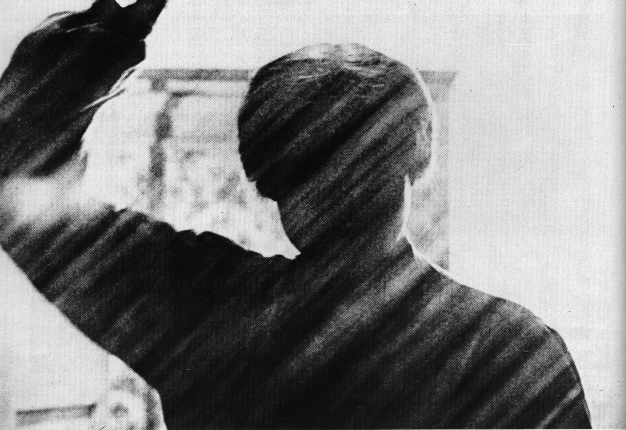
Action code:
- Man and woman in hotel room
- He takes his shirt off, she puts hers on
- Both get smartly dressed
- He kisses her passionatly
- She leaves him alone in the room
Empirical code:
- Zooming in on building window: Creates suspense for the audience wondering what is happening inside
- Mentions of the 'airport' creates mystery of where he is going
- Mystery of what the man and womans's relationship is
- Car horn heard makes the viewer wonder who is there and where the women is going and who with
Semantic code:
- Woman is young, glamourous and proffesional (smartly dressed)
- She has some control over him, tells him what to do and insists upon what she wants
- Blonde hair with bright white shirt and bright lighting suggests goodness and possibly setting her up to be a victim
- Man is young, attractive and seemingly respectable/charming
- Imperfections (exwife)
- He sits in the chadows with dark hair and black trousers, connoting secrets and decietReferential code:
- Pheonix, Arizona (gives knowledge of place/city)
- Time (2:43) gives context to the affair, as viewer would see it as suspiscious, meaning it never has to be directly said
Symbolic code:
- Cheap hotel suggests affair
- Dark, shadowy room implies secrets and deceit
Wednesday, November 4, 2009
Levi-Strauss Narrative Analysis
Levi-Strauss argued that narrative has two main characteristics which are:
1. That it's made up of units that are put together according to certain rules
2. That these units form relations with each other based on binary pairs or opposites, which provide the basis of the structure
Pale Rider
(Directed and Starring Clint Eastwood)

Binary Opposites:
- Quiet v Loud (sounds of the horse riders)
- Still v Action
- Peaceful village v Speed/Charging/Panic
- Green trees v Dry, sparse plains
- Steady camera v Panning movement
- Action v tension
- Happy, upbeat music v Tense music
- Slow editing v Fast choppy editing
- Steady camera v Frantic, fast camera movements
- Calm v Panic
- Life v Death
- Bright light v Dull light/silhouette in forest
- Panic v Mourning
- Sun v Storm
- Night v Day
- Country v Village
- Attacker v Victim
- High angle (HA) v Low angle (LA)
- Black horses v White horse
- Open space v Enclosed
- Threat v Safety
- Spiritual v Everyday (Horse disappearing in normal village environment)
Die Hard
(Directed by John McTiernan, Starring Bruce Willis)

Binary Opposites:
- Outside v Inside
- Open v Enclosed
- Black titles v Coloured titles
- Subtle music v Dominating music
- Older characters v Young children
- Showing faces v Over-the-shoulder (OTS)
- Empty v Crowded/Busy/Frantic
- Chatty v Silent/Moody
- Happy driver v Reserved passenger
- Direct address (DA) v Low angle (LA) v High angle (HA) (CCTV)
- Silent, dark, enclosed lift v Open, colourful, loud party
- Laughing v Tense music
- Happy party v Sinister street
- Relaxed v Arguing
- Yellow lighting inside v Blue street lights
- Tense, minor music v Party music
- Life v Death
- Domestic issue v Life/death issue
- Trivial matter v Serious
- High tech v Old fashioned
- Informal clothing of main character v Formal of the approaching men
- Present v Past
- Home v Away
- American v European
- Repeated photos v Real life people
- Marriage v Career
- Villains v Hero
- Organised/efficient villians v Idleness of hero
Monday, October 19, 2009
Preliminary Exercise Evaluation
(http://www.youtube.com/watch?v=65SbmS7VoAI&feature=player_profilepage)
1. Who I worked with and how we split the task between us:
- My group consisted of George Henry, Michael Greene, Despina Christodoulou and myself
- We decided to have an extra 40 minute group meeting to finalize the planning and the roles we would each have in order to prepare fully for filming session, to ensure it would run as smoothly as possible. In our meeting we decided not to have a leader, but make decisions as a group as there were so few of us, and we could easily communicate
- When planning, we all contributed to the ideas process, and distributed the planning sheets (storyboard, shot list, script) evenly
- To decide what each person should do when filming, we looked at a real film set. Normally you would find:
Director: Is in charge of the film crew, calls everyone to attention and tells them what to do
Production Assistant: Ticks off the shots done, and organises the Director
Sound Technician (and assistant): Checks the sound quality before filming begins and during, to ensure quality, and decides on what microphones to use (e.g. boom, shot gun)
Camera Technician (and assistant): Checks framing/movement of camera, and general visuals
Light Technician (and assistant): Checks quality of lighting of shot, and sequence, deciding on what possible extra lighting may be needed
Actor: Person(s) appearing in shot
Runner: At the command of every other role, ensuring they have what they need
- As there are only four of us, two acting throughout (Despina and I) and one partially (George), we picked the main roles needed. Michael and George shared the role of being Director and Production Assistant. The other would be Camera Director and Sound Director. Whenever Despina and I were not in shot, we would aid the others in these tasks. In each set up (second time around), all four of the group would watch back the shot to check whether it needed re-filming, either for sound or image reasons. We decided against having a lighting technician, as we knew this task was only to practise continuity, not image/lighting quality and the light on set was adequate
- We all contributed to the editing, however I was absent for the most part, and so George, Despina and Michael did the majority. I made sure I knew the processes they went through, and the mistakes/successes so as to benefit for when I'm am doing the main task
2. How we planned our sequence:
- To plan our sequence, we first thought of the rough story idea and agreed on it as a group. When thinking of the idea, we made sure to include a conversation in order to practise the shot reverse shot continuity technique, as well as some movement to include match on action
- Before writing down this idea, we walked it through, making sure it was practical and possible to shoot, as well as thinking where the camera/actors would be placed. We agreed the idea would work
- We then transferred this idea onto our storyboard (to visualise the final sequence and to communicate with every member in the group the details of the shot transitions, sound, framing, camera/actor movement so we all had the same goal), the shot list (to minimise the amount of set ups needed and to film in the most efficient order) and the script (so the actors would know what they are saying)
- On the day, we began by walking it through again to remind every role of what they are doing, and so the actors can practise the script and movements, and then we could being the filming
3. What technology did you use to complete the task, and how did you use it?
Hardware used:
- Canon HDV Mini DV Camcorder
- Tripod (to ensure steady shots)
- Shotgun mic (we decided against using the boom mic as we were filming in a small room, and so therefore we thought the voices could be heard adequately not to need it)
- Headphones (so the sound technician can only hear the sounds that are being recorded, and so can decide whether the voices can be heard or if there is background noise/feedback)
- PC based digital editing suite
Software used:
- Adobe Premiere Pro (razor tool to cut the clips, source and output monitors to view the clips and the working progress, two video and audio tracks to edit between, cut transitions, on board titling software for the text, drag and drop tool to order the clips, non-linear editing to edit in chosen order)
4. Factors we took into account when planning, shooting and editing:
- We had to think about our time management, to make sure we could fit every shot into the 1 hour shoot allocated. Therefore, we couldn't make it too complicated and had to use a location near by
- For the location, we had to think about where we could have enough space to fit all the equipment. There was also the factor of surrounding sound, like background noise from the surrounding school other groups, as well as the light sources avaliable. We chose an office in the media block as it was convinient, free from the other groups and closed off from the other rooms
- We had to think about the skills we had when assigning roles, and as we haven't previously worked together, this task was more challenging, as well as the fact, we had to double up as there were so few of us. Our story needed two girls to be actors, so me and Despina were chosen, despite the fact I have been previously wary about acting, but this forced me to work out of my comfort zone
5. FINAL SEQUENCE
Successes:
- In shot 1 (0:04-0:07), where I walked in the shot it clean and steady
- From shot 1 to shot 2 (0:04-0:12 there is a successful example of match on action, as the cut from one side to the other of the door as I walk through it shows the door opened the right amount, and so the shots flow into each other as they would in real life.
- The pan across the room (0:16-0:17) is an establishing shot, so the audience knows the space relation between the characters
Possible improvements:
- In hindsight, we could've considered the framing of every shot more than we did. They all need to be tighter, to cut out distracting background and bring the audience closer to the action and characters. With the shot of George (0:22-0:24), the framing didn't work as the space was limited to put the camera in the right place, meaning we needed to think more carefully about space when deciding on set
- The conversation needs to slow down, to properly see the shot reverse shot technique, and to avoid confusing the audience
- The sequence doesn't have seamless editing, however this is not due to the editing but due to not filming a wide enough range of shots, such as filming the conversation in a master shot. With a wider range of shots, the whole sequence could be slowed down so the audience know what is going on
- The voices of the actors can be heard, but the background noise is also significant, so in hindsight we could've filmed somewhere where less people are walking past the room
6. What I have learnt from this activity and how I think this will be significant when completing the rest of my foundation coursework:
- I learnt a lot during the planning process, particularly the importance of the storyboard as we didn't spend enough time on the storyboard, and so we didn't all fully know what our final goal was as a team, which slowed the filming process
- Personally, I have found that acting is not for me as I am not 'camera friendly' or comfortable in front of the camera, and there are many better at acting than myself
- When things when wrong during the filming process, I found I reacted poorly, as I stopped communicating with my team as much, and feel I could have done a lot more to motivate, as the other members of my team did. This is something I am now aware of, and so will be concious to help out and communicate more when problems occur
- I learnt to think about the practically of the project, e.g. time allocation, props/actors/space avaliable and to properly assess each aspect to ensure they are possible
- I learnt a lot about constructing continuity, including not breaking the 180 degree rule, not breaking the 30 degree rule, using shot reverse shot when filming conversation and using match on action to create a flowing sequence
- I am now aware of how to use the audio equipment including the headphones, boom mic and shot gun mic to minimise feedback/background noise and to ensure the voices of actors/noises on set can be clear and distinct
Group 3C - Preliminary Exercise Paperwork (Storyboard, Shot list, Script)
Friday, October 9, 2009
Propp Narrative Analysis
Aladdin
(Directed by Ron Clements and John Musker, Starring Scott Weinger and Robin Williams)
(http://www.youtube.com/watch?v=RNFs_sESJEc)
Vladimir Propp (1895 to 1970), analyzed the basic plot components of Russian folk tales to identify their components. In his narrative theory, there are a number of set common characters who each have specific narrative functions. The events of a narrative can also summarised in 31 steps of generalised events.
Character Types:
- Villain: Jafar
- Donor: Jafar
- The (magical) helper: Genie/Magic carpet
- Princess: Jasmine
- Her father: Sultan
- The dispatcher: Jafar
- Hero: Aladdin
- False hero/anti-hero: Jafar
Brief synopsis of film (using Propp's theory):
- Villain receives information about hero: Jafar, the Grand Visier to the Sultan, wants to obtain a magic lamp from the cave of wonders. He realises only the 'Diamond in the Rough' can enter the cave, and this is Aladdin
- Hero is introduced: Jasmine, the Sultan's daughter, is annoyed at her father for the restrictions he is placing upon her, so escapes to the local market, where she meets a street urchin called Aladdin
- Villain carries away hero: Jafar, knowing Aladdin is the 'Diamond in th Rough', captures him and tells Jasmine that Aladdin is dead
- Hero discovers lack and decides on counteraction: Jafar disguises himself then proceeds to take Aladdin to the Cave of Wonders, where he is told that only he can touch the magic lamp
- Hero is tested: Aladdin finds a magic carpet, which aids him and helps him to find the magic lamp. However Abu, Aladdin's pet monkey, steals a ruby, causing a cave in
- Hero responds to test: The magic carpet aids Aladdin in escaping the cave
- Villain and hero in direct combat: Jafar attack Aladdin in an attempt to retrieve the lamp, however Aladdin survives and maintains possession of the lamp
- Hero gets magical agent: Aladdin rubs the magical lamp, revealing the Genie who informs Aladdin that he will grant him three wishes
- Hero given new appearence: Aladdin first wishes to become a prince, to enable him to marry Jasmine. She, however, declines him until she realises his true identity
- Hero is persuit then rescued from persuit: Aladdin is captured again by Jafar, whose guards chian him and through him into the ocean. Aladdin escapes by using his second wish
- False hero exposed: Aladdin returns to the palace, revealing Jafar's fiendish plan to Jasmine and her father, the Sultan
- Jafar steals the magic lamp, then wishes to become a Sultan and a powerful sorcerer. He, with is new powers, sends Aladdin off to 'a far away place'
- The magic carpet aids Aladdin in his flight back home where, with the help of Jasmine, he attempts to steal back the magic lamp. However, they are caught and Jafar attacks him
- Villain is punished: Jafar thinks of himself as the most powerful being in the world, but is reminded by Aladdin that Genies are more so. Jafar attempts to counter this by wishing himself to be a genie, forgetting that Genies are not free beings, and is sucked into the lamp, which is then placed into the Cave of Wonder
- Task resolved by true hero: Aladdin uses his third and final wish to free Genie, who then goes off to explore the world
- Hero marries: The Sultan then changes the law to enable Aladdin to wed Jasmine, and they proceed to celebrate their engagement
Critique of Propp's theory:
- The 8 character types are faulted by the fact one character can have multiple functions at the same time (for example Jafar being the villain, donor, dispatcher and false hero), which according to Propp's theory can not be. Also, the 31 narrative functions are hard to fit into the story, espicially with the last section as the story does not finish when the false hero is exposed. This reveals a major flaw to Propp's theory as despite it being applicable to the simple Russian folk tales or fairy stories he analyzed, it is unable to be applied to more complicated stories, which is counter to what it claims to do. With the complexity shown in narrative and characters in modern day films, it seems clear to me that Propp's theory has lost much of its appeal
Friday, October 2, 2009
Todorov Narrative Analysis
Edward Scissorhands
(Directed by Tim Burton, Starring Johnny Depp and Winona Ryder)
(http://www.youtube.com/watch?v=TOwyBimCqN4)
Agents:
- Protagonists are Edward scissorhands and the woman telling the story
- The antagonist or opposing agent in the appears to be Edward's struggle with his lack of hands and his loneliness, implying that these factors will be the theme of the film
Equilibrium:
- The town is sleeping, Edward remains in his house and the two are seperate, unknowing of each other
- The isolation of Edward is shown by using sweeping master shots to create the sense of vast space in his mansion, showing how big, dusty and empty his surroundings are
- There is a cutaway from the woman talking to the dark, blue coloured town with snowy, cold weather to emphasise the cosy, warm colours of the bedroom, enhancing the bed-time story nature of the scene
- The character of Edward is hidden right up until the end of the opening sequence, and even then he is only shown from behind. This shows the mystery behind the character and creates suspence for the audience
- The prop of the machines within the mansion add to the sense of mystery, as they are all covered in cobwebs and the creaking noise is very sinister
- The prop of the disembodied hands, blue in colour, fading in and out of sight hints to the theme of the film
- The costumes of the old woman and the child in the bedroom are very traditional, with the old fashioned red dress and white dress. This puts the audience in the mood of a cosy fairy tale, but the juxtaposition of the eerie machinery, suggests there will be a twist
Disruption/Disequilibrium:
- In the opening, the disruption of the inventor dieing is explained, causing Edward's loneliness and need to change
- The future disruption is hinted at, as there is the theme of Edward being lonely and this woman seems to know him, so they have to meet, changing his loneliness
Clues to Hero's Journey:
- There is a view over the local town next to Edward's house, and Edward is shown looking out of his window at the town, suggesting that the town is where he will end up
- The connection of the woman and Edward is not explained, so the film must also explain their meeting
How equilibrium is restored and what the new equilibrium is (from film knowledge):
- The town and Edward become seperated again when the villagers chase him and he is forced to find refuge. The town then forgets about him, and he is once again isolated
- The new equilibrium is that the girl (Kim) and Edward still have a connection, and she visits him in secret, so his isolation is slightly broken
Thursday, October 1, 2009
Film Sequence Deconstruction
Little Miss Sunshine
(Directed by Jonathan Dayton and Valerie Faris, Starring Abigail Breslin)
(http://www.youtube.com/watch?v=CthB71GqYa0)
Deconstruction of sequence and continuity techniques used:
- From 0:12 to 0:26 shot reverse shot is used to show the action of Olive talking and the reaction of the audience. The 180 degree rule is also kept to, as the audience are always looking to the left of the frame and Olive to the right
- From 2:49 to 2:50 match on action is used as Olive runs through one shot to the next. It is timed so that her movements look continuous and smooth
- 2:54 to 3:02 shows CU's and WS's of the family running on stage. They have been edited together to make sure the characters are in the right place at the right time, even when they are in the background (match on action). This action is also broken up by showing reaction shots of the mother, judges and audience
- 3:38 to 4:38 continues to show the match on action during the whole family dance. They have cut the action up with reactions of the audience and shown different angles of the dancers but they are always matched up to make the movements look smooth and make sense. The cut away of the dancers and audience also stays with the 180 degree rule, so the audience are always looking left to avoid confusing the viewer
- Throughout the sequence, only cuts are used to keep the fast pace of the actors movement. This also avoids complicating the sequence, so the audience can understand what is going on
- There is an establishing shot (master shot) of the stage and the audience at the beginning. This sets the scene and allows the camera to zoom in to the characters later with the viewer still understanding where they are and the distances between the characters
- The 30 degree rule is never broken as when the camera cuts to the same character, it is always from a different angle or direction. For example, from 2:52 to 2:58 it cuts from LS in front of the father, then a MS hand held forward track behind him, then a MLS from his side

